


Phantom
- The Boat
- Racing Record
- Why Super Spars?
- Masts
- Booms
- Options
- Testimonials
- Tuning
- Useful Links
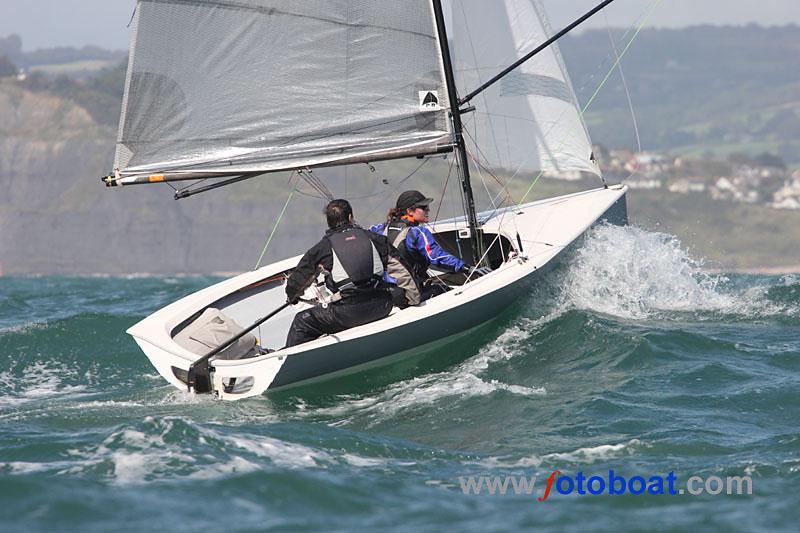
The Phantom was designed by Paul Wright and Brian Taylor in 1971. They wanted to produce a single-hander that was exciting to sail, manageable and at the same time affordable to build. It isn't possible to design a boat that will accommodate all weights, even in these days of 'wings' and equalisation systems.
As there were already boats on the market for the lighter helms they decided to design a boat that was both comfortable and fast for larger sailors. A Phantom sailor shouldn't weigh less than 10 stone, and is most suitable for those in the weight range of 12 -18 stone (76 -115 Kg).
One advantage with the phantom is that both the class association and the designers view the development of the class in a proactive manner always providing that care is taken not to outclass older boats. Latterly the design has been modified to incorporate self-draining cockpits and carbon spars. Additionally the design allows freedom in cockpit design and sailors are therefore able to develop cockpit sail and rig control systems that suit their individual requirements.
A one design high performance single-hander the Phantom has a hard chine hull with a deep 'V' bow, a flat run aft, and planes easily. With her lightweight hull and large rig on a stayed mast she has a high power to weight ratio, but is stable and responsive. There is no trapeze or spinnaker and she can carry a wide range of helm weights. The Phantom is suitable for home construction using the stitch and glue method or can be bought professionally built in GRP foam sandwich, or wood.
The Phantom is available in a variety of designs.
These are:
Our reliable light weight carbon rig range has been designed for the sailor weight range that the Osprey class targets. Our lightness for the right stiffness tubes are targeted at the three crew weight categories.
The recently added small diameter high modulus tubes have been designed to achieve the essential balance between section diameter, wall thickness and weight. We have spent a lot of time optimising this balance and believe we have this balance right.
Sails are designed to match the rig ensuring that there is a close relationship the mast, sail and helmsman.
M7 Aluminium
Carbon 55mm and 60mm Diameter
Carbon High Modulus Carbon 47mm Diameter 22% smaller diameter
B1 Aluminium
Round Carbon Boom 80mm Diameter
Oval Carbon Boom 90mm x 45mm
Spinnaker Pole
42mm Aluminium Pole Carbon Single PoleMast Options
Stainless Steel Spreader Bracket with aluminium Spreaders
Carbon Spreader Bracket with Carbon Spreaders
Fully Adjustable Spreader System
Extended Gooseneck
Carbon Sail Track
Ultra Low Stretch shrouds
Halyard lock
Performance Rigging
Mast and Boom Bags for UV Protection
J J Boats have been testing the new Super Spars carbon Phantom mast.
The following is a report from one of the sailors using the mast at Alton Water in the Winter 2012/2013:
"The mast has been used on four occasions now in a mixture of conditions and with different sails. The spreaders have been set to the North recommendations and the lowers are kept very tight especially with the P&B sails.
1st time I was out, were the last two races of the Alton winter series in F4/5 with a P&B flat sail. Initial feelings after coming straight from using the Selden S2 are the rig is not as flexible in the top section, but with 15 stone this was not a disadvantage. By having the stiffer bottom section and using a lot of lowers the sail, which usually has a bad crease at the bottom batten due to luff starvation, set well. The mast does not feel as stiff as the S3 Selden, but I have not had a chance for a direct comparison yet. Only one other competitive Phantom was sailing but results were two wins.
I used the mast over Xmas in a charity race on the river Orwell in vicious 35knot gusts and felt it was giving good control and allowing the rig to depower. Again the P&B flat sail was used.
The Alton Water Lemons Hill race in the New Year was held in gusty F2/3, sailing in open water and along tree lined banks.
The full cut North was used. Plenty of power was provided allowing the rig to be eased up wind.
Another win by 2 1/2 minutes on handicap but again no competitive Phantoms to sail against. I have struggled to use this sail on the Selden rig, but it worked well on the Super Spar.
Alton Water Frostbite series had a fleet of 8 Phantoms, 2 with CST rigs. Weather F2/3, sailed with the P&B medium sail. The rig worked well and the boat speed was good, at least as fast as the CST boats. Two bad starts resulted in catch up and only a 2nd and 3rd, with 1st in the final race in dying breeze. It was noted how much lowers I was using but I think the P&B cut needs a very stiff bottom section."
J J Boats conclusion is that after the first few outings the new Super Spars mast has a good gust response in the top section but you can still generate plenty of power in the rig for lighter airs.